


Post
How to Improve the Construction Payment Process
Built Product
Learn More


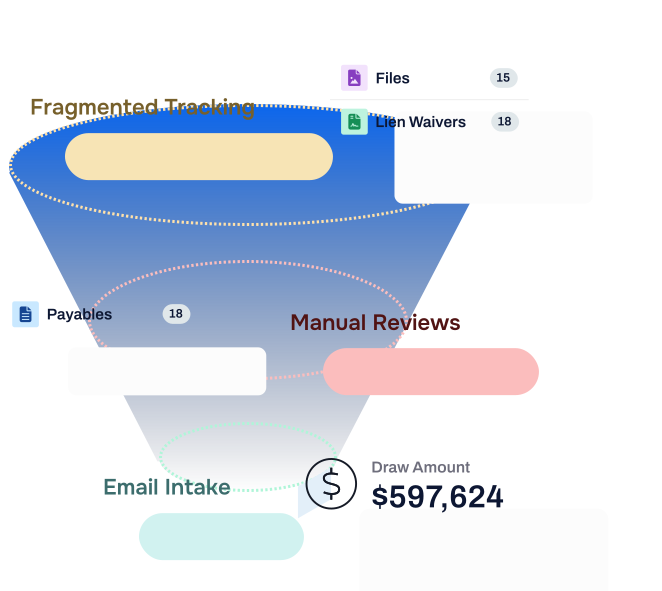
Every construction draw request forces a lender to answer one question before releasing capital: does the documentation, field progress, and compliance status on this project justify disbursement? Manual review of that question takes 5 to 10 business days per draw, driven by document reconciliation across disconnected systems, inspection scheduling delays, and exception handling that consumes senior reviewers. Lenders using centralized draw management platforms have reduced the cycle to under 3 days, enforce policy on every draw, and scale individual administrator capacity past 130 active loans.
A construction draw request is the formal submission a borrower makes to a lender, requesting the release of funds for completed work on a construction loan. For construction loan administrators, draw specialists, and operations leaders, each request is a critical control point where funding speed, compliance, and portfolio risk intersect.
In construction lending, speed matters, but so do rigorous controls. McKinsey research tracking more than $1 trillion in capital projects found that 98% of large construction projects face cost overruns or delays, with the average cost increase reaching 80% of the original budget value. In this environment, the draw review process serves as a primary risk checkpoint where minor documentation gaps can be early warning signs of deeper project distress.
During the 2008 financial crisis, construction and development loans became noncurrent at significantly higher rates than other CRE categories, reinforcing why draw-level controls remain critical today.
This article explains what a construction draw request is, how the lender-side review process works, which documents are required, how long approvals typically take, what causes delays, and how lenders are using automation to improve speed, strengthen compliance, and scale operations without adding staff.
A construction draw request is the borrower’s formal submission requesting funds for completed work under a construction loan. While loan origination sets the initial terms, the draw process is where those terms are enforced throughout the project lifecycle.
The borrower submits the request, and the lender receives a package of documents, progress evidence, and funding information that must be reviewed before approval and disbursement. Each request moves through review, validation, approval, and funding, with the lender responsible for verifying that all conditions are satisfied before capital is released.
In the construction loan lifecycle, draw requests represent the “active” phase where the bank’s collateral is being built. Because the loan is disbursed in stages, the lender must ensure that for every dollar released, there is a corresponding increase in the value of the property.
It is important to distinguish between the request (the package of data and documents provided by the borrower) and the disbursement (the actual transfer of funds). A request initiates a review process; a disbursement is the outcome of a successful approval.
A payment application is submitted by a contractor to the project owner to request payment for work. A construction draw request is submitted by the borrower to the lender to request the release of loan funds. For the draw request form from the owner side</a>, see how owner-developer teams structure submissions at scale.
From a lender’s perspective, this distinction is critical for two reasons:
A draw request is a package, not a single document. Missing or inconsistent documentation is the primary reason for funding delays. Lenders review these items to verify work completion and mitigate lien risk. Depending on lender policy, the package may also include borrower authorization confirming the requested disbursement.
These support the specific amounts requested. Lenders validate that these costs align with approved budget line items and ensure that funds are not being “front-loaded” for work not yet performed. Discrepancies here often trigger a request for revision.
Lenders review the SOV to confirm that “percent complete” figures for each line item align with reported progress. The same McKinsey research found that 98% of large construction projects face cost overruns, with the average cost increase reaching 80% of original budget value, making budget drift the central risk the SOV is designed to catch.
These confirm that contractors have been paid and are not asserting claims against the property. Lenders must track conditional (issued before payment) and unconditional (issued after payment) waivers.
Compliance Note: Missing or incorrectly timed lien waivers are the #1 cause of funding holds. Automated tracking is now a necessity for multi-state portfolios.
Documentation of approved shifts in scope. Lenders confirm these are fully executed and reflected in the updated budget to prevent mechanics’ lien risk or “off-book” work from creating liability.
Third-party verification of progress. Lenders compare these results to the SOV to ensure the bank is not over-funding based on self-reported data. Mismatches here are a common trigger for draw rejections.
Lenders typically withhold a portion of each draw (often 5-10%) until specific milestones are met. Note: As of January 1, 2026, California Civil Code Section 8811 implements a 5% retention cap on many private projects, making precise holdback tracking a legal compliance requirement.
Draw delays rarely stem from a lender’s unwillingness to fund. Instead, they are often a data architecture problem. When documentation, inspection data, and budget information live in disconnected silos (email, PDFs, and spreadsheets), manual reconciliation becomes the only way to move forward.
The friction points of manual review are manageable at a small scale, but they become a structural chokepoint as a portfolio matures.
Most lending teams lack a dedicated back-office for draw administration. Because manual steps are difficult to parallelize, capacity only grows by adding staff, creating a “staffing ceiling” that limits the bank’s growth.
Internal benchmarks show that manual workflows typically cap an administrator at roughly 60 active loans. To scale beyond this, lenders must move from adding headcount to redesigning the digital workflow. Built customer data shows that replacing manual reconciliation with a centralized workflow can increase capacity to 130–190 loans per administrator—effectively doubling throughput.
To scale, the review process must move from a reactive series of tasks to a structured, 5-step workflow.
There is a significant gap between traditional manual timelines and modernized benchmarks. Timelines often stretch due to incomplete packages, inspection scheduling delays, and fragmented systems requiring manual data entry.
| Workflow Stage | Industry Baseline (Manual) | Automated Workflow |
| Submission & Intake | ~3 days | ~1 day |
| Approval & Funding | ~10 days | ~2 days |
| Total Turnaround | ~13 days | ~3 days |
In practice, delays are usually driven by incomplete packages, inspection timing, and manual reconciliation across systems rather than any single approval step.
Top-performing lenders operate with a different architecture that prioritizes transparency and real-time data.
| Metric | Manual Process | Automated (Built) Process |
| Draw Turn Time | 7–10 days | 1–2 days |
| Loans Per Admin | ~60 | 130–190 |
| Inspection Speed | 5–7 days | <36 hours |
| Audit Trail | Reconstructed manually | Captured automatically |
Lenders can use this framework to evaluate their current draw approval process:
Lenders using Built to modernise draw workflows consistently report faster funding cycles, lower administrative burden, and portfolio growth without proportional headcount increases.
Faster funding, consistent controls, and scalable draw operations: these are the practical, measurable outcomes of centralised draw management. Lenders grow their portfolios without increasing overhead or compromising risk discipline.
Talk to a member of our team today.
Manual draw review takes 5 to 10 business days from submission to funding. Most of that time goes to document reconciliation, inspection coordination, and exception resolution across disconnected systems. Lenders using Built’s centralized draw management workflows consistently fund within 48 to 72 hours of submission. Automated intake validation catches incomplete packages at submission, and integrated inspection tools eliminate the scheduling lag that adds days to field verification.
Truliant Federal Credit Union, for example, reduced inspection turnaround to two days or less after adopting Built’s digital inspection and draw coordination tools.
The most effective approach separates routine validation from exception handling. Built’s AI Draw Agent performs the initial data sweep, validating requested amounts against the approved budget, checking for document presence and consistency, and flagging policy violations. Human reviewers then focus exclusively on resolving the exceptions the AI surfaces. Built’s internal benchmarks show 95% faster draw approvals and 2x more risks flagged compared to manual review, because the AI checks every line item against lender-defined policies on every draw, not just a sample.
Missing or incorrectly executed lien waivers trigger funding holds more often than any other single factor, making incomplete documentation the leading cause of draw delays. Inspection coordination compounds the problem because scheduling third-party site visits and reconciling results against the budget consumes 5 to 7 days in a manual workflow. Underlying both issues is system fragmentation. When budget data, inspection reports, and draw packages live in separate systems, administrators spend hours reconciling information before they can begin the actual review.
Structured digital intake enforces completeness at the point of submission, so every draw package arrives with the required invoices, lien waivers, and inspection results before a reviewer opens it. This matters for credit unions in particular, where smaller, less specialized teams handle the same compliance requirements as larger banks. Built’s platform then applies the credit union’s own policies and procedures to every draw automatically, eliminating the review variability that creates compliance exposure when different administrators handle the same loan type differently.
Lenders including Zions Bancorporation have scaled construction portfolios without proportional headcount increases by replacing manual reconciliation with a centralized digital workflow. Built’s platform benchmarks show administrators managing 130 to 190 active loans, up from 60 in manual environments. The AI Draw Agent extends that capacity further by automating the routine validation steps that consume the majority of review time, maintaining 100% policy adherence across every draw.
A complete draw package typically includes the following:
Missing or inconsistent documentation in any of these categories is the primary driver of funding delays and draw rejections.
Built’s draw management platform removes manual steps and streamlines collaboration throughout the entire draw workflow.


