


Conditional vs Unconditional Lien Waivers: When to Use Each in Construction Payments

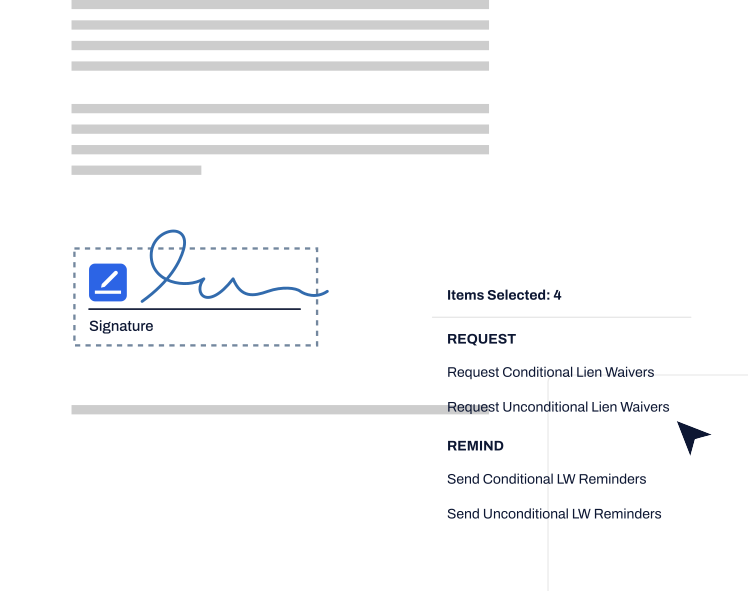
Signing an unconditional lien waiver before payment clears can permanently forfeit your lien rights on money you never receive. A conditional waiver takes effect only once payment posts. If the check bounces after a conditional, your lien rights stay intact. Sign an unconditional, and those rights are gone whether the money arrives or not.
With project volumes rising, getting this wrong carries real cost. For owners and developers, it can delay draw funding and hold up distributions. For general contractors, it can stall sub payments and expose retention.
Built connects 300 lenders with 78,000+ contractors across 580,000+ active projects. This article covers when each type applies and how to protect yourself.
A conditional lien waiver takes effect only once payment is received and cleared. An unconditional lien waiver takes effect immediately when signed, regardless of whether payment actually arrives. The distinction matters because signing unconditional before payment clears can waive your lien rights on money you never see.
This guide covers both types, the four subcategories they form (conditional or unconditional, partial or final), and how construction teams manage them at scale. Lien waivers are standard across construction finance, but they carry real consequences if misused.
Whether you’re a general contractor preparing a pay application, a lender approving a draw, or a developer funding a project, knowing which waiver applies at which point prevents disputes, reduces payment delays, and keeps projects moving.
What Are Lien Waivers?
A lien waiver is a legally binding document used in construction to confirm that a contractor, subcontractor, or supplier has been paid or will be paid for their work or materials. By signing the form, the party waives the right to file a mechanics lien for that amount, which helps keep funding on track and projects moving forward.
In every U.S. state, contributors to a construction project have the legal right to file a lien if they are not paid. These claims attach to the property title and must be resolved before the asset can be sold or refinanced. A lien waiver form offers a proactive way to manage these rights and reduce the risk of payment disputes.
Functionally, a waiver acts like a receipt. It documents who has been paid, how much was paid, and what the payment covers. These forms are frequently exchanged during draw requests and progress payments, making them essential for compliance, funding, and lien law protection.
There are two main types of waiver of lien: conditional and unconditional. The correct form depends on whether payment has already been received or is still pending.
What Is a Conditional Lien Waiver?
A conditional lien waiver is your safest option for payment exchanges. It is used before payment is received and only takes effect once the funds are actually received and have cleared. Look for language like “upon receipt of payment” or “provided payment is received” to confirm that it’s conditional.
- When to use: When submitting an invoice, draw request, or accepting a check that hasn’t cleared yet.
- Protection: It’s a promise to waive rights, conditional on the payment being successful. If the check bounces, your lien rights remain intact.
What Is an Unconditional Lien Waiver?
An unconditional lien waiver is used after payment has been made and verified. By signing, the party immediately and irrevocably gives up the right to file a lien for the stated amount and timeframe.
- When to use: Only after the payment has cleared your bank account and you have full access to the funds.
- Risk: These forms take effect immediately upon signing. If you sign one too early and the payment fails, you lose your lien rights permanently.
Conditional vs. Unconditional: Key Differences
| Feature | Conditional lien waiver | Unconditional lien waiver |
| Timing | Submitted before payment is received. | Submitted after payment is received and cleared. |
| When Effective | Only after the specific payment has cleared (the condition is met). | Immediately upon signing. |
| Risk to Contractor | Low. Lien rights remain protected until funds clear. | High. Signing too early waives rights, even if the payment fails. |
| Waiver Statement | “I agree to waive my lien rights upon receipt of this payment.” | “I confirm I have received payment and waive my lien rights.” |
The Four Types of Lien Waivers
Beyond the conditional and unconditional distinction, waivers are also categorized by the scope of work they cover. This creates four main types that construction professionals must manage:
Conditional waiver and release on progress payment
A conditional waiver and release on progress payment waives lien rights for work completed through a specific date, but only after the corresponding progress payment has been received and cleared. Until the payment condition is met, the contractor or subcontractor retains full lien rights.
This is the most commonly used waiver type during active construction. It’s exchanged with each draw request or progress billing cycle. States like California and Texas require statutory language for this form, using non-compliant wording can invalidate the waiver entirely.
Unconditional waiver and release on progress payment
An unconditional waiver and release on progress payment immediately and irrevocably waives lien rights for work through a specific date. Unlike its conditional counterpart, this form takes effect the moment it is signed, regardless of whether payment has actually cleared.
Only sign this waiver after the progress payment has been deposited and confirmed in your account. Signing before funds clear is the most common and costly mistake in construction payment management.
Conditional waiver and release on final payment
A conditional waiver and release on final payment covers all remaining lien rights on the project, including retainage. It only becomes effective once the final payment is received and cleared. This waiver is exchanged at project closeout when all work is complete and the final draw is submitted.
Because this waiver covers the full remaining balance, the payment amount and scope must be verified carefully. Any discrepancy between the final invoice and the waiver can delay project closeout and funding release.
Unconditional waiver and release on final payment
An unconditional waiver and release on final payment permanently and immediately waives all remaining lien rights on the project. Once signed, the contractor or subcontractor has no further claim against the property for any unpaid work or materials.
This is the last waiver signed on any project. It should only be executed after the final payment, including retainage, has been fully received and confirmed. There is no reversing an unconditional final waiver.
How to Choose and Review the Right Construction Lien Waiver
Even small mistakes in lien waivers can lead to lost rights, delayed payments, or compliance issues. Before signing, or asking someone else to, check the following:
- Waiver type (conditional or unconditional): Use a conditional waiver if payment hasn’t been received. Use an unconditional waiver only when payment is confirmed and cleared. Signing the wrong type at the wrong time is the most common and costly mistake.
- Payment amount and scope: The dollar amount and through date should match your invoice exactly. If you’re billing through March 31 for $\$10,000$, the waiver should reflect that. Any mismatch can hold up funding or cause disputes.
- State-specific rules: Some states, like California and Texas, require statutory waiver forms with specific, exact language. Using the wrong version or language could invalidate the waiver entirely.
Want to simplify this process? Try our free lien waiver generator to automatically create compliant forms based on your payment type and state.
Stop the Paperwork Headache: Automate Conditional & Unconditional Waivers
Ditch the spreadsheets! Get one platform to create, send, track, and file all your conditional and unconditional lien waivers instantly.
How Construction Professionals Can Manage Lien Waivers at Scale
Tracking lien waivers across a portfolio is about protecting payments, ensuring compliance, and maintaining project velocity. Here’s how to build a smarter, scalable process.
1. Centralize tracking and storage
Consolidate waiver records in one platform to eliminate version control issues, reduce email churn, and improve visibility for all stakeholders.
2. Automate form generation and routing
Use tools that auto-generate the correct waiver based on payment status, draw cycle, and jurisdiction, reducing manual errors and delays.
3. Ensure legal accuracy
Confirm amounts, dates, and scope before waivers go out. Mismatched data between the draw and waiver form can create serious funding issues or rights exposure.
4. Account for state-specific rules
Some states, like California and Texas, require statutory waiver forms. A smart system flags these variations and ensures compliance.
5. Maintain an audit-ready record trail
Archived, searchable waiver history supports faster funding, dispute resolution, and project closeout, and reduces your legal exposure.
How Built Automates Lien Waivers
Managing lien waivers manually slows down funding and introduces risk. Built automates the entire waiver process, collecting conditional waivers with each draw request and triggering unconditional waivers only after payment is confirmed.
This creates a consistent, compliant, and trackable process across every project.
Builders like Rod Heisler have seen the difference firsthand:
“No more chasing down conditional or unconditional waivers after payment. It’s all part of the process in Built. Our subs enter invoices, sign the waiver, and the system handles the rest.” —Rod Heisler, Heisler Construction
With Built, lien compliance becomes automatic, not a back-office burden. That means fewer delays, cleaner audits, and stronger relationships across the payment chain.
Want to see how it works? Talk to our team to learn how Built streamlines lien waivers for lenders, builders, and borrowers.
Conditional and Unconditional Lien Waivers FAQs
What is the difference between a conditional and unconditional lien waiver?
A conditional lien waiver only takes effect once payment is received and cleared, so if the check bounces, your lien rights remain intact. An unconditional waiver takes effect immediately when you sign it, regardless of whether payment arrives. That means if the payment fails after you sign an unconditional waiver, you’ve given up your lien rights on money you never received. The conditional version protects you, while the unconditional version assumes trust.
When is it safe to sign an unconditional lien waiver?
Sign an unconditional waiver only after the payment has fully cleared your account. For checks, that means waiting for the hold to lift, and for ACH transfers, that means confirming the funds have settled, not just that the transfer was initiated. Some teams sign unconditional waivers at the same time as a check handoff, which creates unnecessary exposure. The safer approach is to wait until funds are confirmed before releasing the unconditional copy.
What happens if payment fails after I sign an unconditional lien waiver?
You lose your lien rights on that payment. Because an unconditional waiver takes effect immediately on signing, it doesn’t matter that the payment never arrived, and you’ve already waived your ability to file a lien against the property for that amount. Built watermarks unconditional waivers at signing so the payer receives a copy, but it can’t be used until the ACH payment fully clears.
What is the difference between a progress and a final lien waiver?
A progress waiver covers work completed through a specific date during construction, clearing lien rights for that billing period but leaving future payments and retainage unaffected. A final waiver covers all remaining rights on the project, including retainage, and is signed at closeout. Both come in conditional and unconditional versions. For more detail on how lien waivers work in construction, see our full guide.
Which states require statutory lien waiver forms?
California and Texas require statutory lien waiver forms with exact prescribed wording, and using non-compliant language can invalidate the waiver entirely. Other states have more flexible requirements, but many contractors and lenders still use standardized forms to reduce disputes. Before drafting or accepting a waiver, confirm which form your state requires and whether any recent legislative changes apply.
Do lien waivers need to be notarized?
Most states don’t require lien waivers to be notarized, though a small number have notarization expectations that vary and have changed in recent years. Always confirm current state requirements before assuming notarization is necessary. If you’re working across multiple states, treat each project’s jurisdiction separately rather than applying one blanket policy.
What is the difference between a lien waiver and a lien release?
A lien waiver is exchanged before a lien is filed, serving as a preventative document signed during the payment process to confirm that lien rights for that payment are being waived. A lien release is a corrective document that removes a lien already filed against the property. For a deeper breakdown of the difference between a lien waiver and a lien release, see our comparison guide.

Lien Waiver Management
Create, send and track lien waivers from one dashboard.
